Heat the room
you’re actually sitting in.
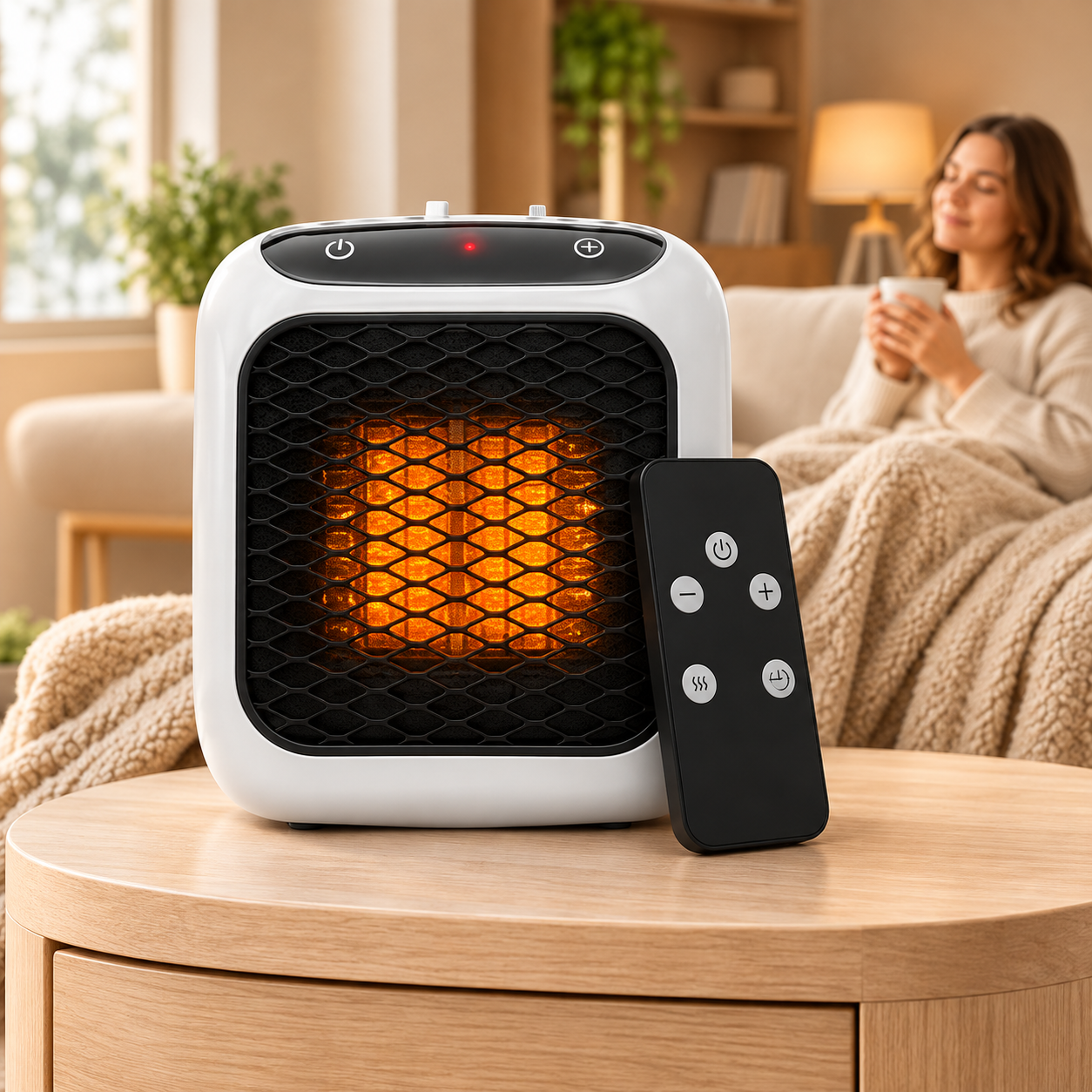
ThermoCore is a plug-in ceramic heater, small enough to disappear into the outlet above your desk. According to the seller it warms a room of up to about 130 sq ft (12 m²) in a few minutes, with an adjustable thermostat, a timer and a remote. Nothing to install and no cable across the floor — it goes straight into the wall outlet.
Why heat one room
Heating the whole house
for a single room
The heat goes into empty rooms
The furnace warms the bedrooms, the hallway and the spare room while you are sitting in one of them. You are paying to heat space nobody is in.
One room is always the cold one
The finished basement, the room above the garage, the bedroom on the north side, the office where the building keeps the thermostat low. The hall thermostat says the house is warm; that room disagrees.
Turn up the furnace or put on a sweater
Turn the furnace up and the bill rises for every room. Leave it down and you are cold in the one room you actually use.
No room for another appliance
A tower heater needs floor space and a cord. A plug-in unit sits in the outlet instead — which is the whole point of this form factor, and also its limit.
Who it suits
ThermoCore is for you
if you…
Need one small room warmer while you are in it, not the whole house
Work at a desk in a room that runs cold and want heat where your feet are
Have no floor space to give up and would rather use the outlet
Rent, and cannot change the building’s heating
Want something that works out of the box, with no electrician
Want to take the chill off a room between furnace cycles
How it works
Plug in, set the temperature, set the timer
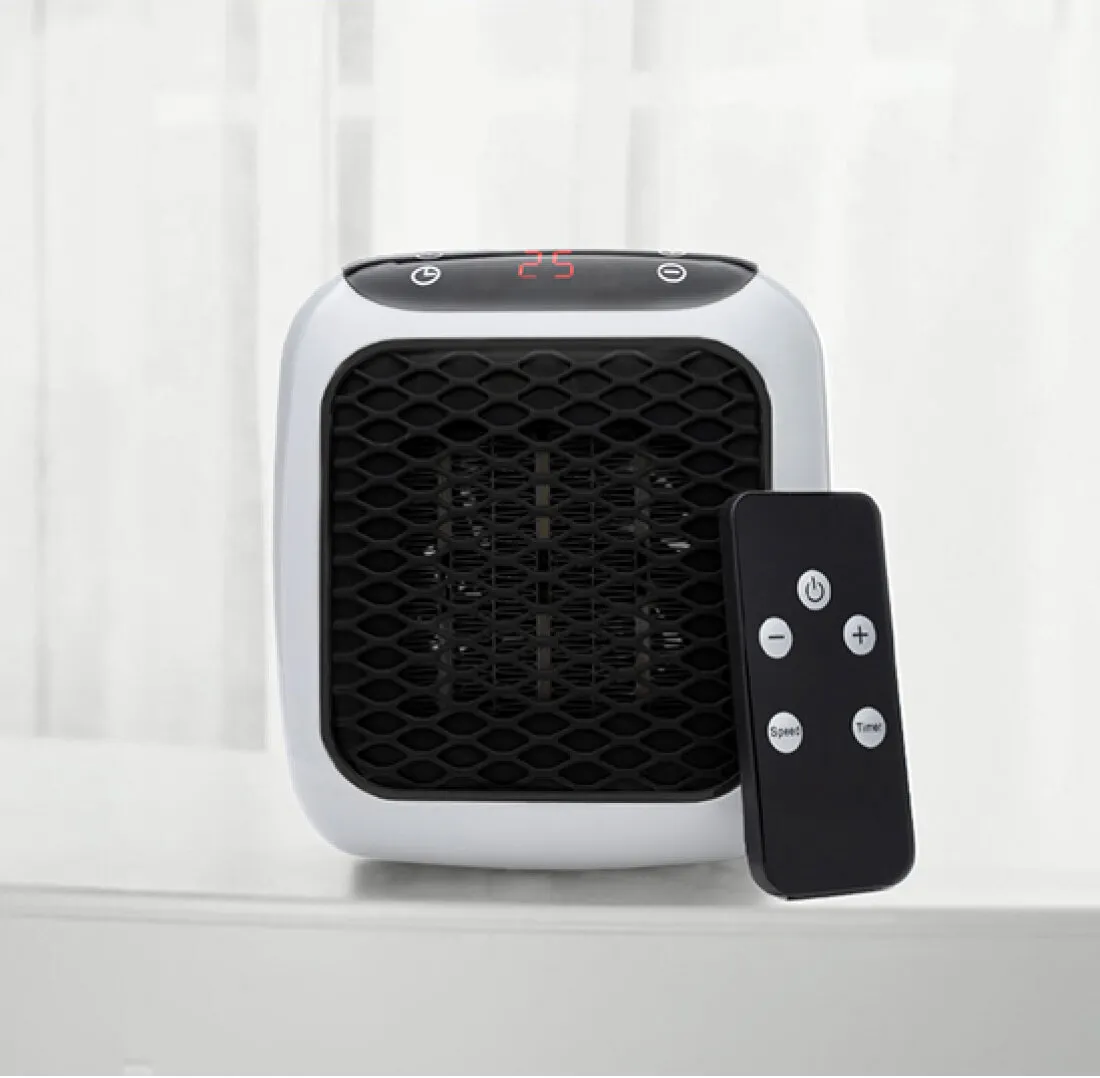
ThermoCore uses ceramic heating plates and a fan, and runs straight from the wall outlet. The controls are on a touch screen on the unit and on the remote, so you can change the setting from the desk or the bed without getting up.
Plug it in
Straight into a wall outlet — no extension cord, no power strip
Set the temperature
Use the touch screen or the remote to pick the temperature you want
Set the timer
The unit keeps running after the room is warm, so the timer is what switches it off
Features
What the seller states
and what it means in use
Ceramic heating plates
The seller states that the ceramic plates warm the room quickly and evenly, hold heat longer and run quietly. How fast the room follows depends on its size, the insulation and the starting temperature — the stated figure is a few minutes for a room of up to about 130 sq ft (12 m²).
Adjustable thermostat
You set the temperature you want rather than picking a fixed power level. Note what the seller’s own FAQ says, though: the unit does not switch off once that temperature is reached — the thermostat sets the target, the timer is what stops it.
Timer
Because the heater keeps running, the timer is the control that matters most. Set it for the time you will be in the room; the seller recommends it specifically to avoid overheating the space.
Remote control and touch screen
The same functions are on the unit and on the remote, so you can adjust it from across the room. On a heater that plugs in behind a desk or a bedside table, that matters more than it sounds.
Overheating protection, auto shut-off, kill switch
The seller lists overheating protection, automatic shut-off and a built-in kill switch, and states that the main frame stays cool to the touch while the grille in front of the plates does get warm. These are backstops, not a substitute for careful use — see the safety section below.
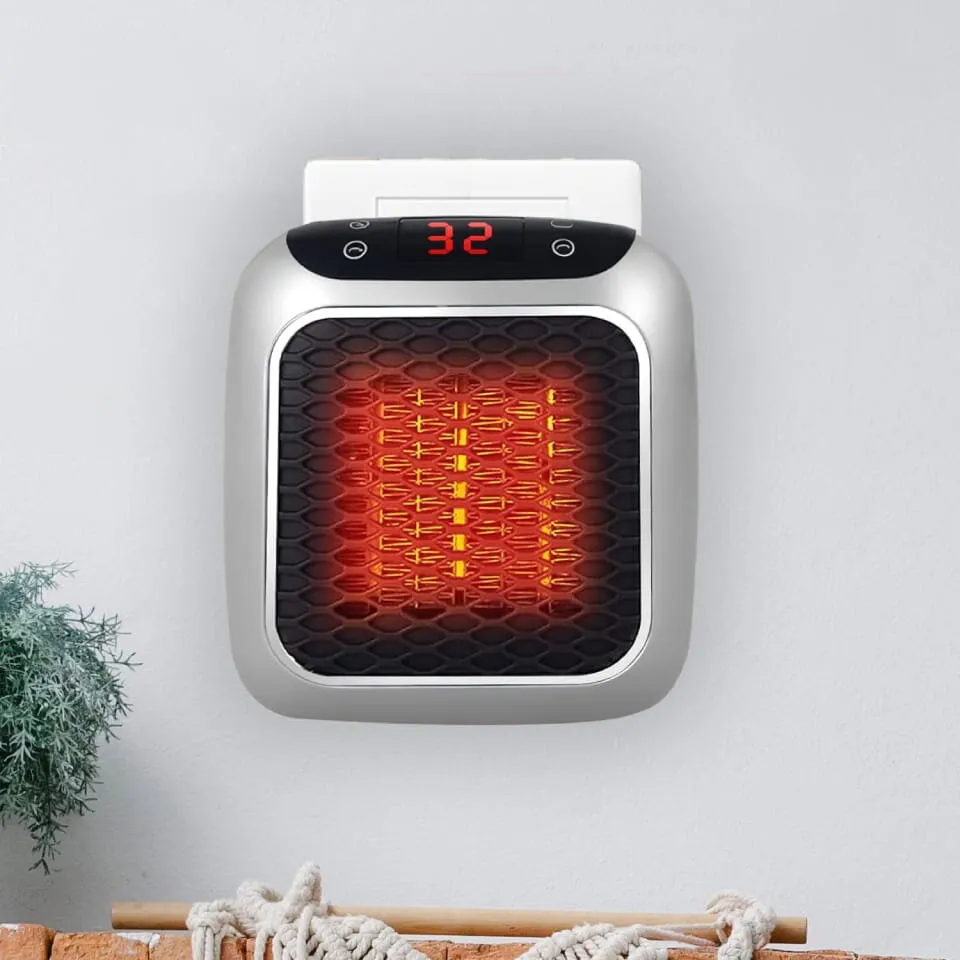
Plugs straight into the outlet
No cord on the floor and no floor space used. It moves from room to room in a pocket. The trade-off is coverage: a unit this size heats one small room, and it has to go wherever the outlet is.
Where the saving comes from
The honest version
of the energy bill
A heater doesn’t make electricity cheaper
A kilowatt hour costs the same whichever appliance uses it. Ceramic plates heat up faster than an oil-filled radiator, but that does not change your rate per kilowatt hour and it does not create heat out of nothing. Any claim that an electric heater uses less electricity while producing more heat is not how the physics works, which is why it is not on this page.
The saving comes from what you stop heating. If you turn the thermostat down and warm only the room you are actually in, the volume being heated drops — and the bill drops with it. It is usually called zone heating, and a small plug-in heater is a reasonable tool for doing it in one room.
Then it depends entirely on how your home is heated now. With a gas furnace, a unit of heat from natural gas costs several times less than the same heat from electricity, so running this alongside the furnace is the expensive way to add warmth — zone heating only comes out ahead if you actually turn the furnace down and heat one room instead of the house. With electric baseboards, a window unit or electric forced air, which is how a great many homes in Quebec, Atlantic Canada, the Pacific Northwest and the US South are heated, you are comparing electricity with electricity, and heating one room instead of five is a straightforward win.
Where you live decides the size of that win. Residential electricity runs under ten cents a kilowatt hour in Quebec, Manitoba and British Columbia, around the mid-teens across much of the United States, and far higher in California, New England and Alberta. Look up your own rate on your last bill before assuming anything: it is the one number that actually settles this, and it is printed right there.
Where people use it
One outlet,
one small room at a time
Home office
In the outlet by the desk during working hours, off when the day ends.
Bedroom
Timer set before bed, so the room warms up and the unit switches itself off.
The cold room
The back extension, the room above the garage, the one the radiators never quite reach.
Away from home
Small enough to take to a cold office or a vacation rental, where you cannot touch the thermostat.
Safety
An electric heater is safe,
when it’s used properly
The unit’s own cut-outs are a good foundation, but most incidents involving portable heaters come down to how they are used, not to the appliance. This applies to any portable heater, and it matters more here because this one keeps running after the room is warm.
Three feet of clear space
Keep curtains, bedding, furniture, papers and anything else combustible at least three feet from the heater — the clearance the NFPA and fire departments give every winter. Never cover it and never use it to dry clothes.
Straight into a wall outlet
No extension cord, no power strip, no surge protector. A space heater draws a high current for hours, and the CPSC and ESFI both advise plugging one directly into a wall outlet, because cords and strips are routinely rated below the heater’s load. If the plug or outlet feels hot, or the breaker trips, stop and have it checked by a licensed electrician.
Use the timer, and keep smoke alarms working
A space heater should be off when you leave the room or go to bed. Since this unit does not stop at the set temperature, the timer is what does it. Portable heaters account for most home heating fire deaths, and a working smoke alarm is what buys you time.
Water and bathrooms
Keep the heater away from water. If you are thinking of a bathroom, check the manual first: only a unit rated for a damp location belongs near a sink or tub, and in both countries the electrical code restricts what may be used near a bathtub or shower. A bathroom outlet is GFCI-protected for exactly this reason.
Children and pets
The seller states the frame stays cool but the grille warms up. Treat the grille as hot, and use an outlet where the unit cannot be reached or knocked.
Check the listing mark
In the United States, look for a Nationally Recognized Testing Laboratory mark — UL or ETL. In Canada, the product must be certified by a body accredited by the Standards Council of Canada and carry a mark such as cUL or CSA, enforced provincially by bodies including the Electrical Safety Authority and Technical Safety BC.
In short
The details
the seller states
Everything below is stated by the seller. Exact dimensions, the output in watts and what is in the box are on the official product page.
guarantee
Try it in your own room
How quickly a room warms up depends on its size, its insulation and its windows — and there is no way to know in advance other than trying it. There is no general cooling-off period for online purchases in the United States or Canada: the FTC’s Cooling-Off Rule covers door-to-door sales rather than websites, and in Canada cancellation rights for distance contracts come from provincial law and generally apply in defined situations rather than for a change of mind. So the 30-day money-back guarantee here is the seller’s own commitment rather than a legal right: send the package back within 30 days for a full refund. Contact support within 30 days of receiving your order, at the address given on the seller’s official website. Separately, a US seller has to ship within the time promised or within 30 days under the FTC’s Mail, Internet, or Telephone Order Merchandise Rule, any written warranty is governed by the Magnuson-Moss Warranty Act, and provincial consumer protection law in Canada gives you rights where goods are not as described. The full terms are on the official sales page.
Order
Order ThermoCore from the official website
The current price, the bundles available, shipping charges and any sales tax, GST or HST are shown on the official order page, where the order is completed.
ThermoCore portable ceramic heater
- ✓Ceramic heating plates, plugs into the wall outlet
- ✓Adjustable thermostat, timer, remote and touch screen
- ✓Overheating protection, auto shut-off and kill switch
- ✓14-day cancellation right and the seller’s 30-day money-back guarantee
Price, currency and availability as stated by the seller on its own website at the time of purchase
Your order details are processed by the seller, not by this page
Questions
Frequently asked questions
How do I set up the ThermoCore?
Plug it into an available wall outlet and switch it on, then set the temperature you want using the remote or the touch screen. According to the seller it warms the room in a few minutes. There is nothing to install and no electrician needed.
How large a room will one unit heat?
The seller states that one unit heats a room of up to about 130 sq ft (12 m²). That is a bedroom, a home office or a small bathroom rather than an open-plan living room. For several rooms at once you would need several units.
Does it shut off once the set temperature is reached?
No. According to the seller’s own FAQ the heater reaches the set temperature in minutes but keeps running, and the seller recommends using the timer to avoid overheating the room. This is worth knowing before you buy: if you want the unit to stop on its own, the timer is the control that does it, not the thermostat. We have gone with the seller’s own answer on this.
Does the heater stay cool to the touch?
The seller states that the main frame stays cool to the touch to avoid accidental burns, and that the grilles in front of the heating plates do get warm from the heat, though not enough to cause harm. Treat the grille as hot anyway and keep children and pets away from the unit while it is running.
How noisy is it?
The seller describes a low, quiet humming sound, similar to brown noise, and says it is not loud enough to wake a sleeping person or interrupt your audio. Any heater that moves air with a fan makes some noise, so expect a steady hum rather than silence.
Can I leave it running overnight?
We would not recommend it. According to NFPA data, heating equipment is one of the leading causes of home fires in the United States, and portable space heaters account for most home heating fire deaths. Fire departments and the Consumer Product Safety Commission advise turning a space heater off when you leave the room or go to bed. Since this unit does not stop at the set temperature, use the timer: set it before bed so the room warms up and the heater shuts itself off. Make sure your smoke alarms work, and never run a space heater in a room where someone is sleeping without that alarm.
Can I plug it into an extension cord or a power strip?
No. Plug it straight into a wall outlet. Space heaters draw a high current for hours at a time, and the CPSC and the Electrical Safety Foundation International both advise against running a space heater from an extension cord or a power strip, because the cord or strip is often rated well below the heater’s load. If the plug or the outlet feels hot, or the breaker trips, stop using it and have the outlet checked by a licensed electrician. In older homes, a 1,500 W heater on a 15 A branch circuit is close to the limit on its own.
Will it cut my energy bill?
Not on its own: it adds consumption. A heater does not make electricity cheaper, and a kilowatt hour costs the same whichever appliance uses it. The saving comes from what you stop heating. What decides the answer is how your home is heated now. If you heat with a gas furnace, electricity costs several times as much as gas per unit of heat, so adding this on top of the furnace raises the bill. If you already heat with electric baseboards or a plug-in unit, you are comparing electricity with electricity, and heating one room instead of the whole house is a straightforward win. Rates matter too: electricity is cheap in Quebec, Manitoba and British Columbia and much dearer in California, New England and Alberta, so the same device pays off very differently depending on where you live.
What certification marks should it have?
In the United States, a space heater should carry the mark of a Nationally Recognized Testing Laboratory — UL or Intertek’s ETL are the common ones. In Canada, electrical products have to be certified by a body accredited by the Standards Council of Canada and carry a recognized certification mark such as cUL or CSA, and provincial regulators including the Electrical Safety Authority in Ontario and Technical Safety BC enforce it. A listing mark is not a formality: uncertified heaters are a recurring subject of recalls. This page does not import or test the product, so check the mark on the seller’s official product page and on the unit itself, and ask the seller in writing before ordering if it is missing.
What if the product is not right for me?
There is no general cooling-off period for online purchases in either country. The FTC’s Cooling-Off Rule covers door-to-door and other off-premises sales, not websites, and in Canada cancellation rights for distance contracts come from provincial law — Ontario’s Consumer Protection Act, Quebec’s Consumer Protection Act and British Columbia’s Business Practices and Consumer Protection Act — and generally apply in specific situations such as goods that never arrive, not simply changing your mind. So the 30-day money-back guarantee here is the seller’s own commitment rather than a legal right: send the package back within 30 days for a refund, through the support contact shown on the seller’s official website. Separately, the FTC’s Mail, Internet, or Telephone Order Merchandise Rule requires a US seller to ship within the time promised or within 30 days and to offer you a refund if it cannot, any written warranty is governed by the Magnuson-Moss Warranty Act, and provincial consumer protection law in Canada gives you rights where goods are not as described. Read the terms on the official sales page before ordering.
Heat the room.
Not the whole house.
ThermoCore is a plug-in ceramic heater with an adjustable thermostat, a timer and a remote — it goes in the outlet, warms one small room, and switches off when the timer says so.
🛒 Order ThermoCorePrivacy and cookies
1. Who handles your information
The operator of this website handles the personal information collected here. Where you buy, the seller handles the information you give it on its own website, under its own privacy policy. This page serves visitors in the United States and Canada, and the rights described below depend on where you live.
2. What we collect
When you visit this page, technical information is collected, including your IP address, the date and time of the request, the pages viewed, and basic browser and device information. If you write to us, we collect what you send. Order and payment details are collected only by the seller: no payment card details are collected or stored on this page.
3. Why we collect it
We use this information to operate the site securely, to understand which pages are useful and to respond to enquiries. We do not sell personal information, and we do not share it for cross-context behavioral advertising within the meaning of the California Consumer Privacy Act as amended by the CPRA.
4. Cookies and similar technologies
Analytics and advertising cookies, including third-party ones, are used only where you have agreed in the banner, and you can delete or block cookies in your browser settings at any time. Strictly necessary cookies keep the site working. Where your browser sends a Global Privacy Control signal, we treat it as an opt-out of sale or sharing, as California requires.
5. Affiliate tracking
The links on this page carry a partner identifier so the seller can attribute a purchase to this website. After you click, the seller or its affiliate network may store data in your browser. That handling takes place on the seller’s side and is governed by its own privacy policy.
6. Your rights in the United States
If you live in California, you have the right to know what personal information we hold, to have it deleted, to correct it, and to opt out of its sale or sharing, under the CCPA as amended. Comparable rights apply under the state privacy laws of Virginia, Colorado, Connecticut, Utah, Texas and a growing number of other states. We do not discriminate against anyone who exercises them.
7. Your rights in Canada
If you live in Canada, the federal Personal Information Protection and Electronic Documents Act gives you the right to access the personal information an organization holds about you and to ask for corrections, and complaints go to the Office of the Privacy Commissioner of Canada. In Quebec, the Act respecting the protection of personal information in the private sector, as amended by Law 25, adds rights including data portability and the right to be informed about automated decisions, with oversight by the Commission d’accès à l’information. Some provinces, including Alberta and British Columbia, have their own substantially similar legislation.
8. How to exercise a right
Write to privacy@thermocore.at. For anything relating to your order, contact the seller’s customer service through the official website.
9. Service providers and cross-border handling
Providers that help us run the website, such as hosting and analytics, handle information on our behalf under contract. Information may be stored or processed in the United States, in Canada or elsewhere, which means it can be subject to the laws of those countries.
10. Marketing messages
Any commercial email we send complies with the CAN-SPAM Act in the United States and with Canada’s Anti-Spam Legislation, including consent where CASL requires it, clear identification of the sender and a working unsubscribe link.
11. Children
This website is not directed at children, and we do not knowingly collect personal information from children under 13, consistent with the Children’s Online Privacy Protection Act.
Terms and conditions
1. What this website is
This website provides information about the ThermoCore heater and links to the seller’s official website. No contract of sale is concluded here. When you buy, your contract is with the seller, whose own terms and prices apply on its own website.
2. Product information
The product details on this page come from material published by the seller and are identified as the seller’s statements. We do not test the product. Where the seller’s published material contradicts itself, we say so rather than choosing the more flattering version. What governs your purchase is the information on the official product page at the time you order.
3. Not advice
The content here is general information, not individual advice on electrical work, fire safety or energy use. If you are unsure about your wiring, your outlets or your breaker panel, consult a licensed electrician, and follow the manufacturer’s instructions.
4. Prices, shipping and taxes
Prices, shipping charges and any sales tax, GST or HST are shown by the seller on its order page. If the product ships to Canada from outside the country, GST or HST, duty and a carrier brokerage fee may be collected on delivery, and those are not part of the price shown at checkout. A US seller is required by the Federal Trade Commission’s Mail, Internet, or Telephone Order Merchandise Rule to ship within the time stated or within 30 days, and to offer a refund if it cannot.
5. Returns and your consumer rights
There is no general cooling-off period for online purchases in the United States or Canada. The FTC’s Cooling-Off Rule applies to door-to-door and other off-premises sales, not to websites, and in Canada cancellation rights for distance contracts come from provincial law, such as Ontario’s Consumer Protection Act, 2002, Quebec’s Consumer Protection Act and British Columbia’s Business Practices and Consumer Protection Act, generally in defined situations rather than for a change of mind. The 30-day money-back guarantee is therefore offered by the seller under its own terms. Any written warranty on the product is governed by the Magnuson-Moss Warranty Act in the United States, and provincial consumer protection and sale-of-goods legislation in Canada gives you rights where goods are not as described. Nothing on this page limits rights you have under the law where you live.
6. Liability
We are not responsible for the content, availability, shipping or handling of third-party websites we link to. Nothing in these terms excludes any liability that cannot lawfully be excluded.
7. Intellectual property
The text and design of this page are protected by copyright. Product names, logos and trademarks belong to their respective owners.
8. Complaints
As no contract is concluded through this website, a complaint about an order goes to the seller. In the United States, complaints about a seller can be filed with the Federal Trade Commission at reportfraud.ftc.gov or with your state attorney general. In Canada, misleading advertising can be reported to the Competition Bureau, and your provincial or territorial consumer affairs office handles consumer complaints.
9. Governing law
Nothing in these terms chooses a law or a forum that would deprive you of the consumer protection of the state, province or territory where you live, and the mandatory consumer law that applies where you live is unaffected.
10. Quebec
If you are reading this in Quebec, note that the Charter of the French Language, as amended by Bill 96, requires commercial publications and websites directed at Quebec consumers to be available in French. A French version of this page is not published yet.
Affiliate disclosure
Commercial relationship
This website contains advertising and affiliate links. We may receive a commission when a visitor buys the product through a link on this page. The commission does not affect the price the seller shows you. We disclose it clearly and up front, as the Federal Trade Commission’s Endorsement Guides at 16 CFR Part 255 require of anyone with a material connection to an advertiser, and as the Competition Act requires in Canada.
Independence
This website does not represent the manufacturer or the official seller. Product details are based on material published by the seller and should be checked on the seller’s official website before buying.
Customer reviews
We do not publish customer reviews on this page. The material available to us carries reviews written for a different brand of plug-in heater, and reproducing them here would present them as reviews of ThermoCore, which we cannot verify. The FTC’s Rule on the Use of Consumer Reviews and Testimonials at 16 CFR Part 465 prohibits writing, buying or disseminating fake or misattributed consumer reviews, and sections 52 and 74.01 of the Competition Act prohibit false or misleading representations in Canada. We will publish reviews once those from the official ThermoCore website are available, quoted word for word.
Seller claims we did not carry over
Advertising claims on the seller’s page that we could not substantiate have been left out of this page. They include blanket energy-saving claims, claims to be a leading or number-one heater brand, recommendations attributed to unnamed experts, aggregate ratings and recommendation percentages we cannot verify, limited-availability and countdown messaging, and the claim that a filter removes bacteria, mold and allergens — a claim that in the United States would make the product a pesticide requiring EPA registration under FIFRA.